Artificial intelligence is no longer a futuristic promise; it is here, embedded in nearly every industry. From drug discovery to financial modeling, from autonomous vehicles to robotics, AI has moved from experimental labs to boardroom agendas. But this progress runs on a very specific fuel: high-performance GPU compute. Just as oil powered the global economy in the 20th century, compute is rapidly becoming the essential resource of the 21st century. Those who control it will dictate the pace of innovation, economic growth, and even geopolitical power.
The Surge in AI Adoption and the Demand for Compute
The adoption curve for AI has been nothing short of explosive. Stanford’s 2025 AI Index Report reveals that 78% of organizations now use AI in at least one business function (up from 55% the year before). This sharp rise reflects not only the popularity of generative AI applications but also the mainstreaming of machine learning in operations, supply chain management, customer engagement, and decision-making.
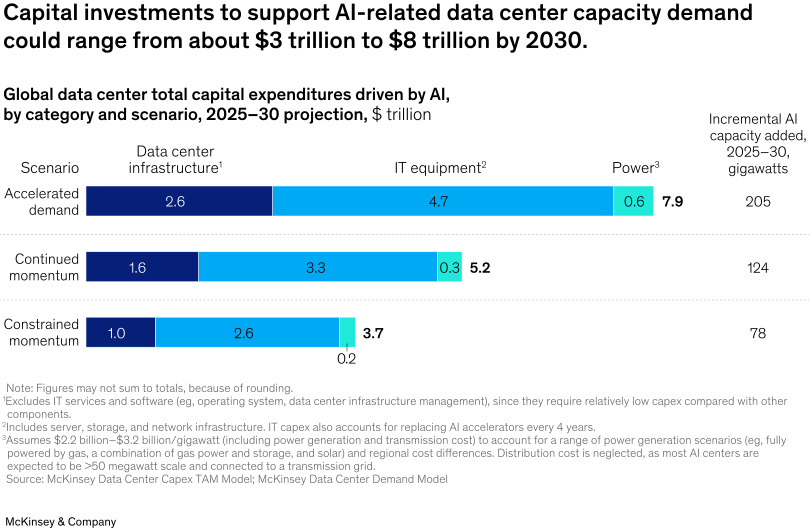
Alongside this adoption, investment in AI infrastructure has surged. Since 2020, AI-related infrastructure spending has outpaced traditional IT spending by six times. McKinsey projects that by 2030, enterprises and governments will pour more than $5.2 trillion into AI-related data centers alone (with a total ~$6.7 trillion in required data center investment across all IT workloads). To put this in perspective, that figure rivals Japan’s entire GDP, underscoring that compute is no longer a back-office IT line item, it is a strategic asset at the heart of economic power.
The Harsh Reality of GPU Scarcity
The rapid rise in demand has collided with hard supply limits. GPUs, the engines of AI, are in unprecedented shortage. In the first quarter of 2025, NVIDIA allocated nearly 60% of its production to enterprise clients, sidelining startups and smaller players. Adding to the crisis, a devastating earthquake in Taiwan destroyed over 30,000 wafers at TSMC, further tightening supply.
These shortages have led to skyrocketing costs. The highly sought-after H100 GPU is being resold at 30–50% above MSRP, with wait times stretching up to a year in some markets. For enterprises trying to maintain competitive timelines, these delays are crippling. Startups, often the drivers of breakthrough innovation, are being priced out of the AI race, not because of a lack of ideas, but because of a lack of compute.
Why Centralized Cloud Models Are Breaking
The traditional hyperscaler cloud model, built for scaling web apps, not training AI models, is buckling under pressure. Capacity constraints have stretched procurement timelines to 20–32 weeks, a delay that can erase competitive advantages in fast-moving markets. Vendor lock-in compounds the issue. Companies tied to one or two providers are left vulnerable to price hikes, restricted quotas, and opaque policies.
The consequences are measurable. Research shows that enterprises deploying AI infrastructure 40% faster than peers achieve 2.3× higher revenue growth and capture 60% more market share. In this environment, speed isn’t just a benefit; it is survival. But with centralized providers unable to keep up, innovation bottlenecks are inevitable.
The Strategic Compute Reserve, Treating Compute as an Asset
Enter the concept of the Strategic Compute Reserve (SCR). Much like airlines hedge against volatile fuel costs or manufacturers secure raw materials through long-term contracts, enterprises must now treat compute as a strategic reserve rather than an operating expense.
A Strategic Compute Reserve ensures predictable, resilient, and flexible access to GPU capacity. It safeguards against supply shocks, shields businesses from price volatility, and guarantees R&D teams the freedom to experiment and scale. Beyond protecting continuity, it provides the speed and reliability needed to accelerate time-to-market, ensuring that innovation pipelines remain open.
How Spheron Powers the Strategic Compute Reserve
Spheron is redefining compute access for the AI era. Unlike hyperscalers, where provisioning can take up to eight months, Spheron reduces deployment cycles by 90%. Enterprises can progress from planning to production-ready AI infrastructure in a few hours.
-
Spheron delivers enterprise-grade GH200 GPUs at $1.84 per hour, or about $1324 per month for uninterrupted access. This pricing is up to 90% cheaper than incumbents such as AWS or GCP. Importantly, Spheron’s transparent model includes bandwidth and storage with no hidden egress fees, a stark contrast to the opaque pricing structures of centralized providers.
-
Spanning 176 countries and backed by more than 44,000 nodes, Spheron’s infrastructure allows companies to deploy AI workloads close to their users. This global footprint reduces latency and ensures compliance with regional data residency laws. For industries like healthcare and finance, where compliance is mission-critical, this local-first architecture is invaluable.
-
By compressing setup into a few-hour cycle, Spheron eliminates the bottlenecks that plague traditional clouds. This speed empowers enterprises to launch, iterate, and scale without losing ground to competitors.
-
Offering bare-metal access without virtualization overhead and advanced networking fabrics such as InfiniBand, Spheron allows enterprises to fully customize their compute stack. From distributed training to high-throughput communications, Spheron provides the flexibility to optimize for the most demanding AI workloads.
Compute as a Geopolitical Resource
The battle for computing extends beyond corporate boardrooms; it has become a matter of national strategy. Governments are increasingly treating compute as a sovereign resource. The U.S. has imposed restrictions on GPU exports to rival nations, the EU is investing billions in sovereign AI infrastructure, and Middle Eastern sovereign wealth funds are making record GPU cluster investments.
This geopolitical lens reinforces the urgency for enterprises. Compute scarcity isn’t a temporary bottleneck; it is a long-term structural reality. Those who secure their reserves today will control their destiny in tomorrow’s AI economy.
Why Spheron is More Than a Cloud Provider
Spheron represents a paradigm shift. It is not merely a cloud service; it is a community-powered compute stack designed for resilience and accessibility. By decentralizing supply, Spheron mitigates the risks of centralization and democratizes access. Its tokenized incentive model ensures sustainable alignment of supply and demand, creating an ecosystem where compute remains both affordable and accessible.
The results are already tangible. Spheron has delivered over $100 million worth of compute, achieved $15 million in annual recurring revenue, and cultivated a thriving ecosystem of startups, enterprises, and Web3 builders. This track record demonstrates that Spheron is not a vision for the future; it is already powering the present.
Conclusion: Fueling the Future with Spheron
The AI revolution is a compute revolution. Enterprises that continue treating compute as a utility will find themselves stalled by scarcity, spiraling costs, and innovation delays. Those who treat computing as a strategic asset will gain the resilience, speed, and flexibility required to dominate in the AI-driven economy.
The question is no longer whether you need AI, but whether you have the compute to fuel it. Spheron provides the infrastructure to transform compute from a bottleneck into a competitive advantage. With unmatched cost savings, global reach, rapid deployment, and architectural control, Spheron is the backbone enterprises need for the AI era.
Ready to secure your Strategic Compute Reserve? Discover how Spheron can transform your AI strategy by visiting Spheron AI or contacting the Spheron team to discuss your compute requirements.