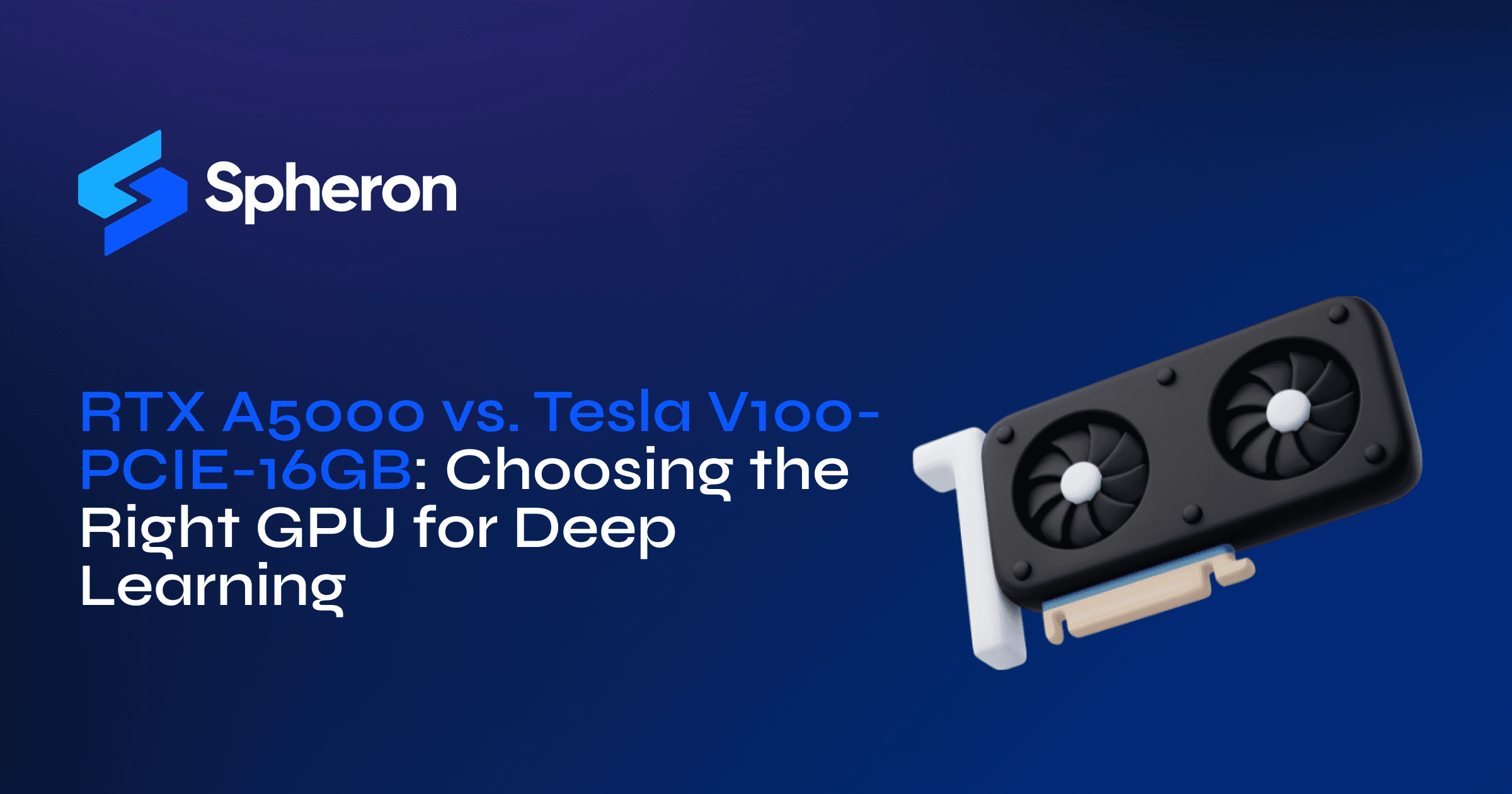
One of the most crucial decisions you'll make when diving into the world of deep learning is choosing the right GPU. GPUs accelerate the processing of neural networks, making them indispensable for deep learning tasks. Today, we'll compare two powerful GPUs: the RTX A5000 and the Tesla V100-PCIE-16GB. Understanding their differences and strengths will help you make an informed decision for your deep learning projects.
Understanding GPU Specifications
Before we delve into the specifics of each GPU, let's break down the key specifications you'll encounter:
-
CUDA Cores: These cores handle parallel computations. More CUDA cores generally mean better performance.
-
Tensor Cores: Specialized cores for handling tensor operations, crucial for deep learning.
-
Memory: The amount of VRAM available for handling large datasets.
-
Memory Bandwidth: The speed at which data can be read and written to the GPU.
-
TDP (Thermal Design Power): Indicates the power consumption and heat output.
These specifications directly impact the GPU's performance in deep learning tasks.
Overview of RTX A5000
The RTX A5000, part of NVIDIA's professional GPU lineup, is built on the Ampere architecture. It's designed for a range of professional applications, including deep learning.
Key Features and Specifications:
-
CUDA Cores: 8192
-
Tensor Cores: 256
-
Memory: 24 GB GDDR6
-
Memory Bandwidth: 768 GB/s
-
TDP: 230W
The RTX A5000 offers a balanced combination of performance, memory, and efficiency, making it suitable for various deep-learning workloads.
Overview of Tesla V100-PCIE-16GB
The Tesla V100-PCIE-16GB, built on NVIDIA's Volta architecture, is a powerhouse specifically designed for deep learning and AI research.
Key Features and Specifications:
-
CUDA Cores: 5120
-
Tensor Cores: 640
-
Memory: 16 GB HBM2
-
Memory Bandwidth: 900 GB/s
-
TDP: 250W
The Tesla V100 is renowned for its exceptional tensor performance and memory bandwidth, which are crucial for large-scale deep-learning tasks.
Tesla V100 PCIe and RTX A5000
Here's a detailed comparison chart of the Tesla V100 PCIe and RTX A5000 graphics cards:
Performance Comparison
Tensor Performance
The Tesla V100's 640 tensor cores provide outstanding tensor computation capabilities, making it highly efficient for training and inference. The RTX A5000, with 256 tensor cores, also offers impressive performance but falls slightly short compared to the V100.
Memory Bandwidth and Capacity
The Tesla V100's 900 GB/s memory bandwidth outshines the RTX A5000's 768 GB/s, allowing faster data transfer. However, the RTX A5000 compensates with a larger 24 GB memory, compared to the V100's 16 GB, beneficial for handling larger datasets.
Power Consumption
The RTX A5000 is more power-efficient with a TDP of 230W, compared to the Tesla V100's 250W. This difference might be crucial for setups with power constraints.
Architecture Differences
Ampere Architecture (RTX A5000)
The Ampere architecture introduces new features like third-generation tensor cores and improved CUDA cores, offering better performance and efficiency.
Volta Architecture (Tesla V100)
The Volta architecture, with its specialized tensor cores, was a game-changer for deep learning when introduced. It remains highly effective, especially for tensor-heavy computations.
Software Support
Both GPUs offer excellent support for deep learning frameworks like TensorFlow and PyTorch. NVIDIA's CUDA and cuDNN libraries ensure seamless integration and optimized performance.
Use Case Scenarios
Best Scenarios for RTX A5000
-
Data Science Workstations: Ideal for professionals needing a versatile GPU for deep learning, 3D rendering, and other tasks.
-
Edge AI: Suitable for deployments requiring high performance with lower power consumption.
Best Scenarios for Tesla V100-PCIE-16GB
-
Large-Scale Deep Learning: Perfect for training large models and running extensive simulations.
-
Research Labs: Beneficial for cutting-edge AI research needing maximum computational power.
Cost and Value for Money
The RTX A5000 is generally more affordable than the Tesla V100, offering great value for professionals needing a balance between performance and cost. The Tesla V100, though pricier, provides unmatched performance for intensive deep learning tasks.
Future Proofing
RTX A5000
With its newer architecture, the RTX A5000 is likely to stay relevant longer, supporting upcoming software advancements and larger models.
Tesla V100-PCIE-16GB
While the Volta architecture is slightly older, the Tesla V100 remains a robust choice for deep learning, though it may be surpassed by newer GPUs in the future.
Integration with Deep Learning Platforms
Both GPUs integrate well with popular deep learning platforms like TensorFlow, PyTorch, and Keras. They also support cloud services such as AWS and Google Cloud, making them accessible for various deployment scenarios.
Pros and Cons
Pros and Cons of RTX A5000
Pros:
-
Larger memory capacity
-
Power-efficient
-
Versatile for various professional applications
Cons:
- Slightly lower tensor performance compared to Tesla V100
Pros and Cons of Tesla V100-PCIE-16GB
Pros:
-
Superior tensor performance
-
High memory bandwidth
-
Excellent for large-scale deep learning
Cons:
-
Higher power consumption
-
More expensive
Conclusion
Choosing between the RTX A5000 and the Tesla V100-PCIE-16GB depends on your needs. If you require maximum tensor performance and are working with extensive deep-learning models, the Tesla V100 is the clear winner. However, if you need a versatile, cost-effective GPU with ample memory, the RTX A5000 is an excellent choice.
FAQs
1. Which GPU is better for beginners in deep learning?
For beginners, the RTX A5000 offers a balanced mix of performance and versatility, making it a more accessible choice.
2. How does power consumption affect performance?
Higher power consumption usually correlates with higher performance but also increases energy costs and potential cooling requirements.
3. Are there any hidden costs associated with these GPUs?
Consider the cooling cost and potential power supply upgrades, especially for the Tesla V100.
4. Can these GPUs be used for purposes other than deep learning?
Both GPUs are suitable for tasks like 3D rendering, scientific simulations, and other GPU-intensive applications.
5. How important is software support in choosing a GPU?
Software support is crucial. Ensure the GPU you choose is compatible with the deep learning frameworks and libraries you plan to use.