The Canadian AI playbook for 2025: talent is here, rules matter, and scale is next. You need GPU infrastructure that matches research depth and business needs. This guide helps you pick the right provider for training, inference, or production workloads. Spheron AI is listed first, and the vendor order is reshuffled to highlight a balanced set of options.
1. Spheron AI
Spheron AI provides straightforward, high-performance GPU infrastructure for model training, inference, and production. It focuses on predictable pricing, bare metal performance, and a simple developer experience. You choose a GPU, launch a machine, and start training without wrestling with complicated setup or noisy neighbor issues. Spheron exposes bare metal H100, B300 SXM, A100 options, and VM tiers so teams can match cost to workload.
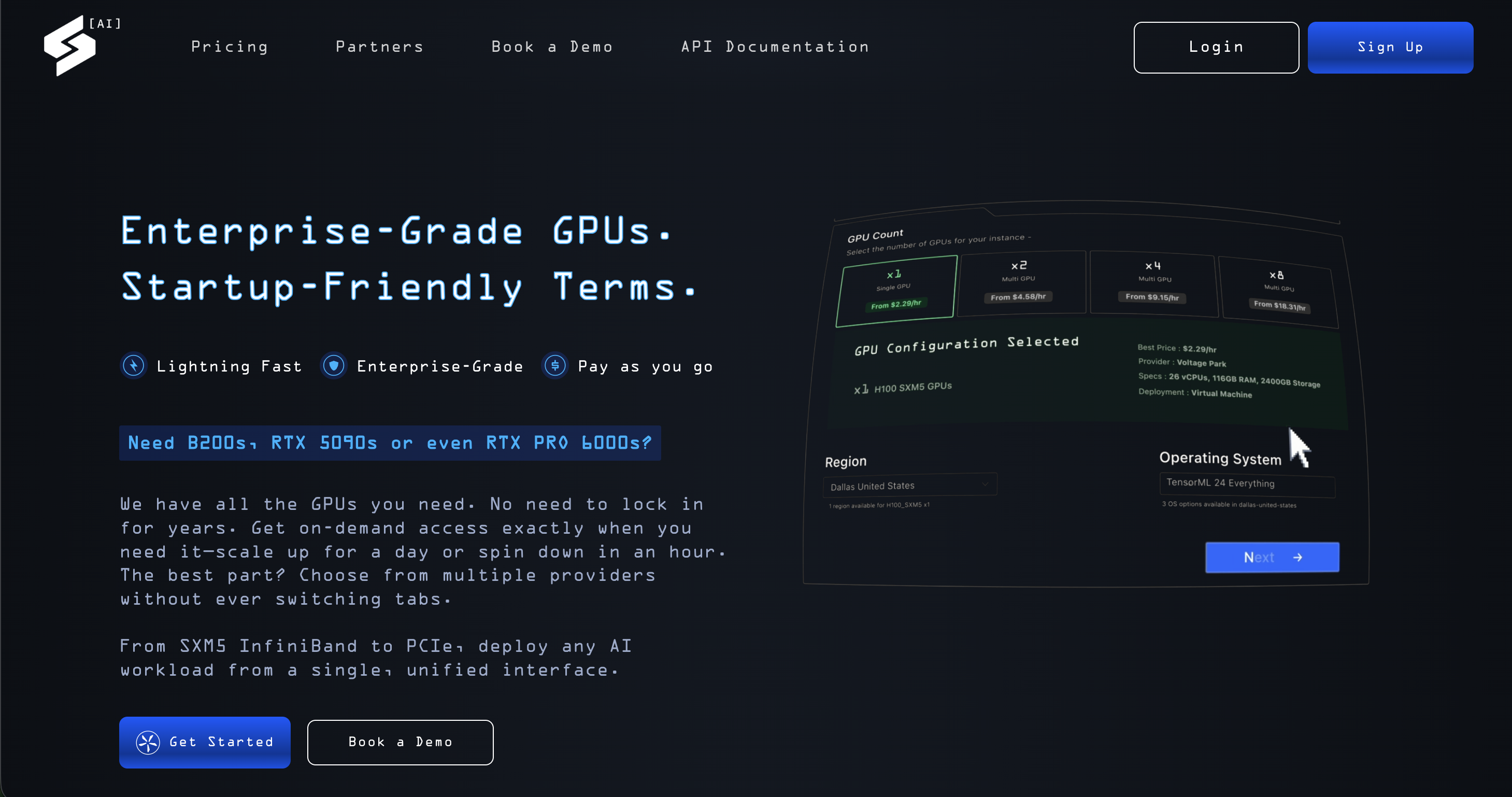
Why teams pick Spheron AI
- Fast start times and consistent performance.
- Bare metal options for heavy training.
- Transparent, predictable pricing.
- Good balance of price and reliability for startups and enterprises.
Spheron AI example pricing table
GPU Model
| | Type | Starting Price (USD/hour) | Notes | | --- | --- | --- | --- | | NVIDIA H100 SXM5 | VM | ~$1.21/hr | Strong for LLM training | | NVIDIA A100 80GB | VM | ~$0.73/hr | Good for mid-size LLMs and CV models | | NVIDIA L40S | VM | ~$0.69/hr | Best for inference workloads | | NVIDIA RTX 4090 | VM | ~$0.55/hr | Great for fine-tuning and diffusion models | | NVIDIA A6000 | VM | ~$0.24/hr | Affordable for research workloads | | B300 SXM6 | VM | ~$1.49/hr | Latest powerful GPU which can handle any task |
Where Spheron fits best
- Heavy LLM training and multi-GPU jobs.
- Production inference that needs stable latency.
- Teams that want simple onboarding and no surprise bills.
2. Lambda Labs
Lambda Labs targets serious research and enterprise training. It offers H100, H200, and A100 clusters with InfiniBand networking. You get prebuilt environments and strong multi-node support. Use Lambda when you need reliable multi-GPU scale and low network latency.
Highlights
- Quick multi-GPU cluster creation.
- Low-latency network for distributed training.
- Preconfigured software stack and good docs.
Best fit
Large LLM training, multi-node research, production-scale experiments.
3. Nebius
Nebius focuses on high-performance clusters and advanced networking. They expose H100, A100, and L40S with InfiniBand. Nebius works well when you need multi-node throughput and infrastructure-as-code integrations.
Highlights
- InfiniBand up to 3.2 Tb/s.
- Terraform and API driven automation.
- Kubernetes and Slurm support.
Best fit
- University labs, enterprises doing large batch training, and teams that automate deployments.
4. RunPod
RunPod provides flexible pod and serverless GPU compute. You can launch containers or serverless endpoints in seconds. RunPod works well for teams that want fast iteration and pay-for-active-use billing.
**Highlights
**- Serverless GPU endpoints and pod instances.
- Custom Docker environments and real-time usage insights.
- Per-second billing for many workloads.
Best fit
- API-first inference, rapid prototyping, short experiments and paid by active compute.
5. Vast.ai
Vast.ai is a marketplace that matches supply and demand to give low-cost access to many GPU types. You can find consumer and data center GPUs through auction-style pricing. Vast is ideal for cost-sensitive experiments and flexible workflows.
Highlights
- Real-time auction pricing and spot options.
- Wide GPU selection from RTX to H100.
- Docker-based deployment and benchmarks.
Best fit
- Cheap experimentation, spot workloads, and projects that tolerate interruptions.
6. Genesis Cloud
Genesis Cloud emphasizes performance and compliance. It offers large HGX H100 and H200 clusters and focuses on energy efficiency and European data residency. Choose Genesis for predictable multi-node performance and regulatory needs.
Highlights
- Large multi-node HGX setups.
- EU data residency and compliance features.
- Green data center options.
Best fit
- Enterprise LLM training, regulated workloads, and teams wanting predictable multi node performance.
7. Vultr
Vultr gives broad geographic coverage and a diverse GPU lineup. It has many data centers and integrates with orchestration tools for multi-region deployments. Use Vultr when you need low latency across locations or a flexible global footprint.

**Highlights
**- Large global footprint with many GPU types.
- Kubernetes and orchestration integrations.
- Competitive entry-level GPU options.
Best fit
- Global inference, regional deployments, and teams needing many small GPU instances.
8. Gcore
Gcore pairs GPU compute with edge delivery. It adds CDN points of presence that work well for serving low-latency AI at the edge. If you need inference close to users, Gcore brings both the network and compute.

Highlights
- Extensive CDN and edge locations.
- Built-in security and DDoS protections.
- H100 and A100 offerings with edge capabilities.
Best fit
- Real-time user-facing applications, gaming, and low-latency inference at scale.
9. Paperspace by DigitalOcean
Paperspace is developer-friendly and covers the whole model lifecycle. It gives prebuilt templates, team collaboration features, and versioning. Use Paperspace for fast prototyping and team workflows.
Highlights
- Easy UI and preconfigured templates.
- Built in collaboration and versioning.
- Good for creators, researchers, and small teams.
Best fit
- Prototyping, mixed teams, and workloads that value developer ergonomics.
10. OVHcloud
OVHcloud offers dedicated single-tenant GPU hardware with strong compliance. It fits teams that want private, isolated machines and clear contractual terms. OVH works well for regulated industries and long-term projects.
Highlights
- Single-tenant dedicated GPUs and ISO certifications.
- Hybrid options to tie on-prem and cloud.
- Transparent pricing and predictable performance.
Best fit
- Finance, healthcare, and enterprise workloads that need isolation and control.
How to choose the right provider
Start by matching workload type to provider strengths. Train large models on bare metal H100 or multi node clusters. Run inference on providers that offer low latency or edge presence. Use marketplace providers for cheap experimentation and use specialized clouds for predictable production needs.
Watch out for hidden costs like egress, cross-region transfer, and long-lived idle resources. Validate SLAs if uptime matters for production. Run a short pilot to measure real world throughput and latency before committing.
Quick buyer checklist
-
Know your GPU memory and network needs.
-
Estimate sustained hours and spot tolerance.
-
Run a perf test with your model and data.
-
Compare true cost after egress and storage.
-
Check data residency and compliance requirements.
Closing thoughts
Canada has deep AI talent and a growing commercial demand. The right GPU partner accelerates your pace of work without adding unnecessary cost. Spheron AI sits at the intersection of performance and simplicity. Other vendors bring specific strengths such as marketplace pricing, edge inference, or enterprise-grade multi-node clusters. Pick the tool that solves the problem you actually have, not the one that looks the flashiest.