Brazil is stepping into a new era of artificial intelligence. Our country has the talent, the ambition, and the growing ecosystem to shape the future of AI in Latin America. What we need now is affordable, reliable, and scalable GPU infrastructure. This choice affects training speed, deployment reliability, and how fast you can move from idea to production.
This guide breaks down the best GPU providers available today and explains how they fit into Brazil’s AI landscape. It covers pricing, use cases, and the kind of workloads each platform is best suited for. Spheron AI appears at the top, as requested.
1. Spheron AI
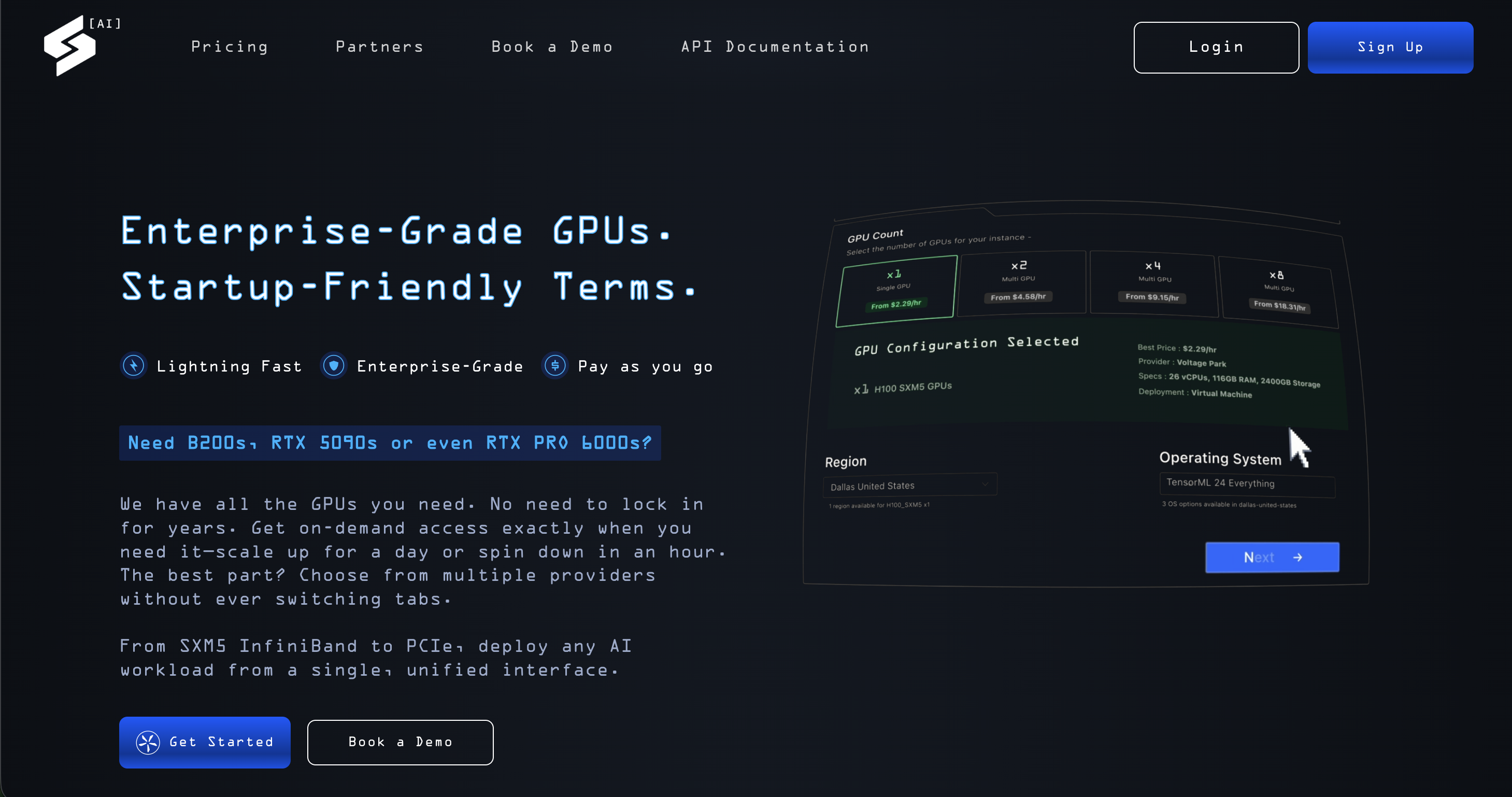
Spheron AI has become one of the most developer-friendly GPU clouds for model training, inference, agent systems, and production AI workloads. It gives direct access to bare-metal GPUs like B300 SXM, H100 SXM, H100 PCIe, and A100. The platform focuses on performance, transparency, and predictable pricing.
Developers like Spheron because it keeps the experience simple. You pick a GPU, launch a machine, and begin training without needing to configure complex infrastructure. Performance is consistent because the machines run bare metal or near bare metal, which avoids noisy neighbors.
Why Spheron AI stands out
Fast machine startup times
Strong support for both training and production workloads
Bare-metal H100 and B300 for high-intensity training
Predictable pricing that stays lower than legacy clouds
Good for solo developers, startups, and enterprise AI teams
Pricing table
| GPU Model | Type | Starting Price (USD/hour) | Notes | | --- | --- | --- | --- | | NVIDIA H100 SXM5 | VM | ~$1.21/hr | Strong for LLM training | | NVIDIA A100 80GB | VM | ~$0.73/hr | Good for mid-size LLMs and CV models | | NVIDIA L40S | VM | ~$0.69/hr | Best for inference workloads | | NVIDIA RTX 4090 | VM | ~$0.55/hr | Great for fine-tuning and diffusion models | | NVIDIA A6000 | VM | ~$0.24/hr | Affordable for research workloads | | B300 SXM6 | VM | ~$1.49/hr | Latest powerful GPU which can handle any task |
Why Brazilian teams choose it
Easy onboarding
Great for heavy LLM training
Affordable for both long and short training cycles
Stable performance with no hidden fees
2. Dataoorts

Dataoorts offers a powerful GPU cloud with dynamic pricing, fast provisioning, and serverless AI APIs. It is known for real-time GPU visibility and flexible DDRA-based pricing, which adjusts cost depending on available capacity. Many AI teams use Dataoorts for its balance of performance and affordability.
Why Dataoorts works well
Fast startup with DMI machine images
DDRA dynamic pricing lowers cost when demand falls
Serverless API makes deployment simple
Great for training, inference, and MLOps pipelines
Kubernetes is ready for advanced workflows
Why it fits Brazil
Efficient for heavy workloads
Affordable for long-running training
Useful for startups, labs, and large corporate AI projects
3. Lambda Labs
Lambda Labs has built a strong reputation for enterprise-grade AI infrastructure. It offers H100, H200, and A100 clusters with InfiniBand networking. Many research labs and AI-focused companies use Lambda for serious model training.
Strong points
Reliable multi-GPU clusters
Low-latency networking for distributed training
Lambda Stack pre-configured environment
Good documentation and support
Why Brazilians use Lambda
Ideal for large LLM and multimodal training
Stable environment for long-term research
Strong for enterprise-grade AI teams
4. Paperspace by DigitalOcean
Paperspace is a clean and modern platform for GPU cloud development. Developers use it for rapid experimentation, training, deployment, and versioning. The platform supports the full model lifecycle and is popular among generative AI creators.
What Paperspace offers
Simple UI and fast access to GPUs
Good collaboration tools for teams
Fast environment setup
Versioning that helps maintain reproducibility
Why it fits Brazil
Great for prototyping
Useful for animation, 3D workloads, and design
Trusted by startups and content creators
5. Nebius
Nebius focuses on high-performance GPU clusters for training large AI models. It is preferred by teams that work on scientific simulations or large-scale learning systems. Its InfiniBand networking offers strong performance for multi-node training.
Nebius highlights
Powerful H100 and A100 clusters
Automated scaling and orchestration
Terraform, CLI, and API support
Kubernetes and Slurm for managed training
Why it works for Brazil
Strong choice for big deep learning workloads
Great for universities, labs, and research institutions
Reliable for long, compute-heavy tasks
6. RunPod
RunPod is popular for its serverless GPU system. Developers can launch inference endpoints instantly, making it useful for production AI applications. It also supports dedicated pods for full training control.
What RunPod does well
Instant serverless inference
Customizable Docker environments
Real-time usage analytics
Hybrid model for training and deployment
Why Brazilian developers choose it
Ideal for API-first AI applications
Affordable for rapid iteration
Good for student projects and research
7. Vast.ai
Vast.ai is a decentralized GPU marketplace that offers some of the lowest prices in the world. Developers who want cheap compute for experimentation often choose Vast. Prices depend on real-time supply and demand.
Why Vast.ai is unique
Auction-style pricing
Wide selection of GPUs
Easy Docker-based deployment
Transparent performance benchmarks
Why it fits Brazil
Perfect for cost-sensitive teams
Good for testing many model configurations
Useful for flexible, non-critical workloads
8. Genesis Cloud
Genesis Cloud focuses on sustainability and European data compliance. It offers strong-performing H100 and H200 GPU clusters. Many enterprise companies prefer Genesis for privacy, reliability, and environmental responsibility.
Genesis Cloud strengths
High-performance GPU clusters
Green energy data centers
Good compliance guarantees
Fast networking across nodes
Why Brazil uses it
Safe choice for regulated industries
Reliable for long-term AI development
Useful for global teams with EU compliance needs
9. Vultr
Vultr offers a wide range of GPU types and has one of the largest global cloud networks. It is well suited for applications that need low-latency deployment across regions.
Why Vultr is valuable
Many data centers worldwide
Large variety of GPUs
Integrated Kubernetes with Run:ai
Good security and compliance
Why Brazilian teams use it
Useful for global AI products
Great for multi-region inference
Affordable compared to larger clouds
10. Gcore

Gcore provides strong cloud performance combined with edge inference capabilities. Companies building real-time systems often choose Gcore because of its CDN network.
Gcore strengths
Wide CDN footprint
Built-in security and DDoS protection
H100 and A100 GPU instances
Support for edge AI serving
Why it fits Brazil
Good for real-time user applications
Useful for fintech, gaming, and interactive apps
Strong for low-latency AI deployments
11. OVHcloud
OVHcloud delivers secure, dedicated GPU instances and strong compliance. It appeals to enterprises building long-term AI systems where privacy and isolation matter.
OVHcloud advantages
Dedicated single-tenant environments
ISO and SOC certifications
Hybrid deployment options
Fast storage and networking
Why Brazil uses OVHcloud
Good for healthcare, finance, and enterprise AI
Predictable and stable infrastructure
Clear and transparent pricing
Conclusion
Brazil is entering the next phase of AI growth, and choosing the right GPU provider is a strategic decision. Spheron AI offers the strongest balance of price, performance, and simplicity for most teams. Spheron AI adds dynamic pricing and a developer-friendly model. Platforms like Lambda Labs, Nebius, and Genesis Cloud provide enterprise-grade power for advanced workloads.
Whether you are a startup building your first model, a fintech company scaling inference across South America, or a research team training multi-billion parameter LLMs, the right GPU cloud shapes your ability to innovate and compete.